


Your relationship with your child can grow, even in the smallest moments.
You know that feeling. The to-do list is a mile long, the morning is already chaotic, and your child is melting down over the wrong color cup. You love them fiercely, but right now, connection feels like a luxury you just don’t have time for.
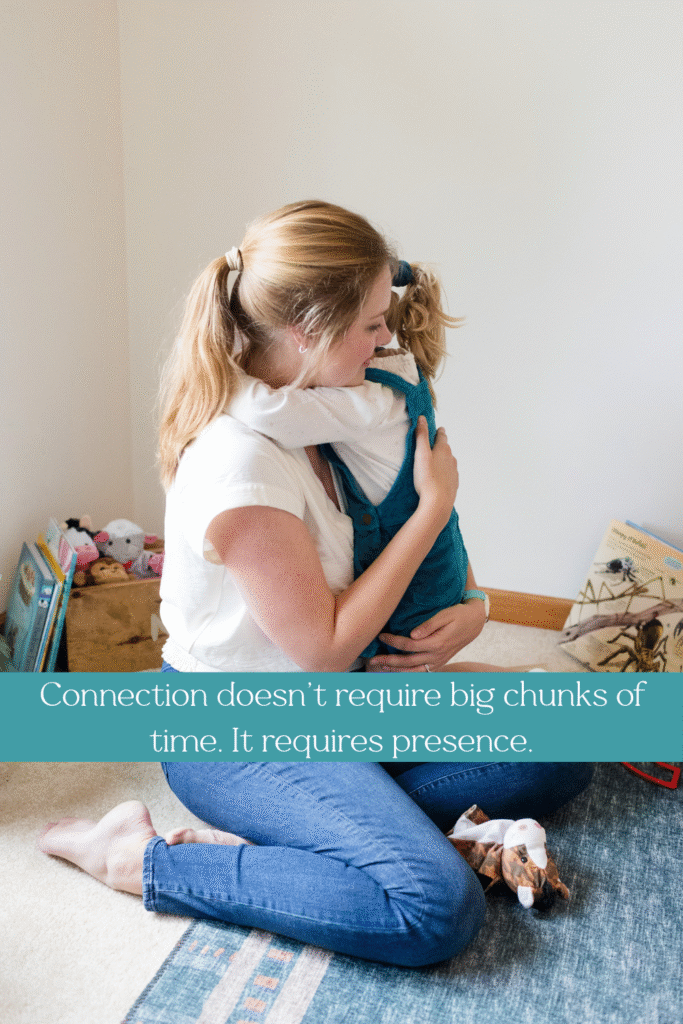
Here’s what I want you to know: connection doesn’t require big chunks of time. It requires presence. And presence starts with you.
The One Thing That Actually Transforms Family Dynamics
Before we talk about what to do with your child, we need to talk about what’s happening inside you.
Parenting and emotional regulation go hand in hand, and not in the way most of us were taught. We weren’t told that our own nervous system is the foundation of our child’s emotional development. But it is.
Children aren’t born knowing how to regulate their emotions. They learn it from us, through a process called co-regulation. In my training with the Jai Institute for Parenting, we describe it as anchor and harbor. First you anchor, steadying your own nervous system. Then you become the harbor, the calm, safe place your child can pull into. When you’re calm and regulated, your presence literally signals safety to your child’s brain, and from that place of safety, they begin to learn how to manage their own big feelings.
The catch? You can’t co-regulate your child if you’re dysregulated yourself.
Understanding Your Window of Tolerance
Psychiatrist Dr. Dan Siegel coined the term Window of Tolerance to describe the zone where you can handle stress, think clearly, and respond rather than react to your child’s emotions.
When you’re inside your window, you can:
- Stay calm during a meltdown
- Listen without immediately jumping to fix-it mode
- Set a boundary with kindness instead of frustration
When you’re outside your window, you might:
- Yell or snap before you even realize it
- Shut down emotionally and check out
- Feel completely overwhelmed by behavior that wouldn’t normally faze you
Sound familiar? That’s not a parenting failure, that’s a nervous system response. And the good news is this: you can widen your window. Through practice, self-awareness, and support, you can build your capacity to stay regulated. When you do, you create the safety your child needs to develop their own regulation skills.
Regulated children happen when parents do the inner work first. That’s why the first step of my CALM framework is C: Connect to yourself first. Your child borrows your calm, but only if you have it to offer.
“But I’m So Busy”: What Connection Actually Looks Like
This is the part I hear most from parents: I want to be more connected, but I just don’t have the time. I understand. And I want to gently challenge the idea that connection requires time you don’t have. Research consistently shows that it’s the quality of small, daily interactions, not the quantity of hours, that builds secure attachment and emotional safety in children.
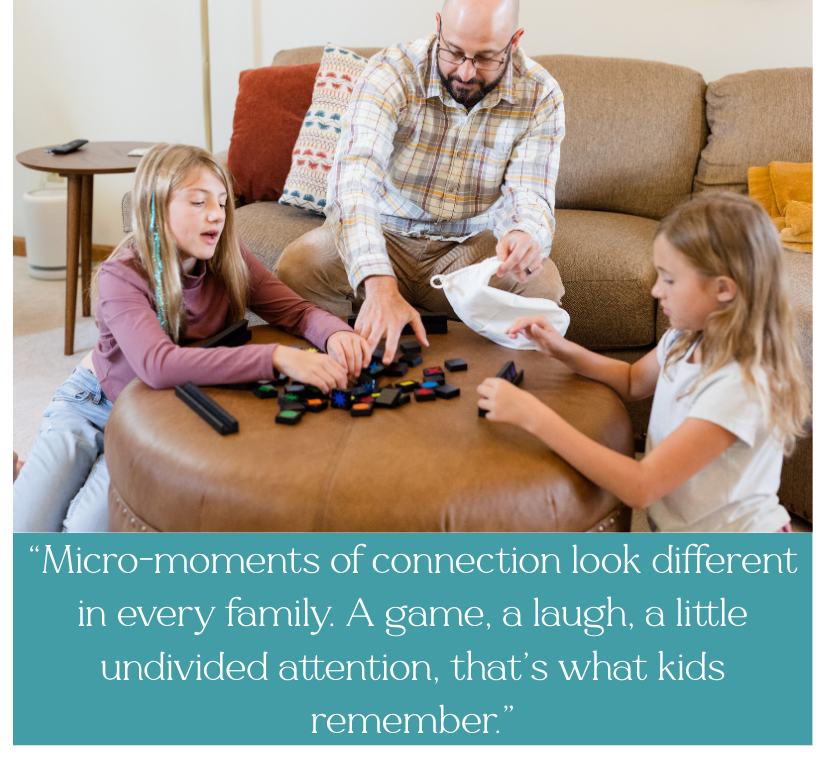
We call these micro-moments of connection, an idea grounded in researcher Barbara Fredrickson’s work on how warmth and connection are built in brief, shared moments. Here’s what they look like in real life:
Morning Transitions
Before you launch into logistics, pause for just a moment. Name one thing you notice about your child. “You seem excited today” or “I love that shirt you picked.” Twenty seconds of being seen can shift the entire tone of a morning.
After School
Instead of immediately asking “How was your day?” give them five quiet minutes to decompress first. Let them have a snack, stare out the window, breathe. Then connect.
Evening Routine
Try replacing “Did you do your homework?” with “What made you smile today?” or “What felt hard today?” You’ll be surprised what opens up. (And when these moments happen at the same time every day, they do double duty. Predictable routines are one of the strongest safety signals a child’s nervous system can receive.)
These aren’t grand gestures. They’re seeds, and seeds planted consistently grow into something beautiful. Notice that each one starts with a pause, with you slowing down first. That’s Connect to yourself first, in real life.
Listen to Understand, Not to Fix
When your child comes to you upset, most of us go into problem-solving mode out of love. We minimize, we advise, we relate:
- “Oh, that’s not a big deal.”
- “Well, did you try talking to them?”
- “When I was your age, I had to deal with…”
These responses come from a good place. But to your child’s nervous system, they feel like a door closing.
Here’s what happens when a child feels truly heard: their brain registers safety. The stress response calms. The prefrontal cortex, the part responsible for reasoning and learning, comes back online. They can actually think again.
You get there not by having the perfect words, but by staying curious:
- “That sounds frustrating. How did that feel for you?”
- “Tell me more about that.”
- “I’m here. I’m listening.”
This is the heart of the rest of CALM. A: Ask what the behavior is saying, getting curious about what’s underneath. L: Linger as the safety signal, letting your face, voice, and body say “you’re safe.” And M: Meet them where they are, not where you want them to be.
Connection always comes before correction. When your child feels safe with you, they become more open to guidance, boundaries, and growth. Not because you demanded it, but because the relationship made space for it.space for it.
Clearing Out Old Parenting Patterns
This season, I’d invite you to ask yourself: What parenting patterns am I ready to let go of?
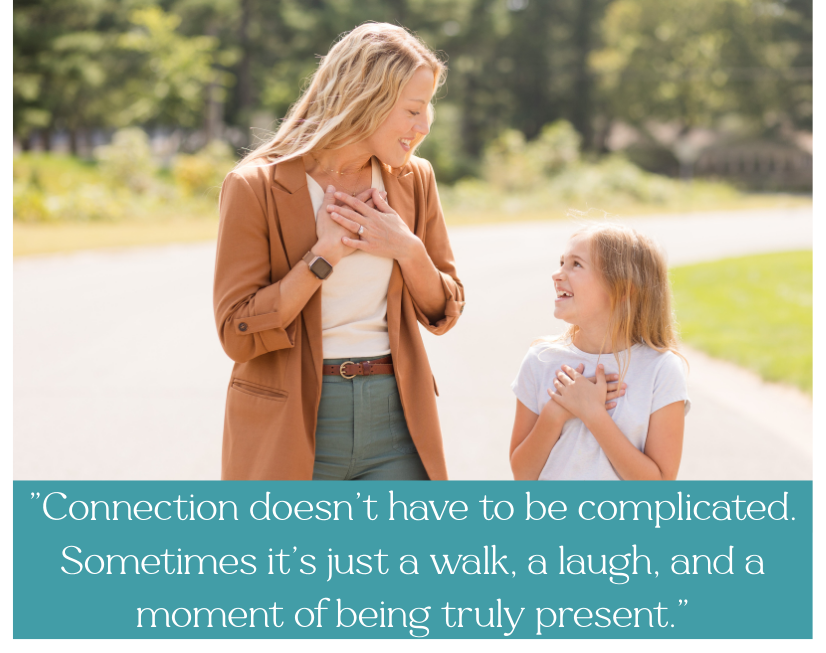
Not out of guilt. Guilt is not a growth strategy. But out of genuine curiosity. What if the most powerful thing you could do for your child this season wasn’t finding a new discipline technique, but simply showing up more regulated, more present, and more willing to listen?
The garden doesn’t bloom overnight. But with small, consistent acts of care, it does bloom.

Want the whole CALM method in one place? Grab my free guide, Chaos to Cooperation: The CALM Method.
Ready to explore what this kind of parenting support could look like for your family? Book a free discovery call with me and visit colorfulmindsparentcoaching.com to learn more about working together, or reach out at amy@colorfulmindsparentcoaching.com.


