


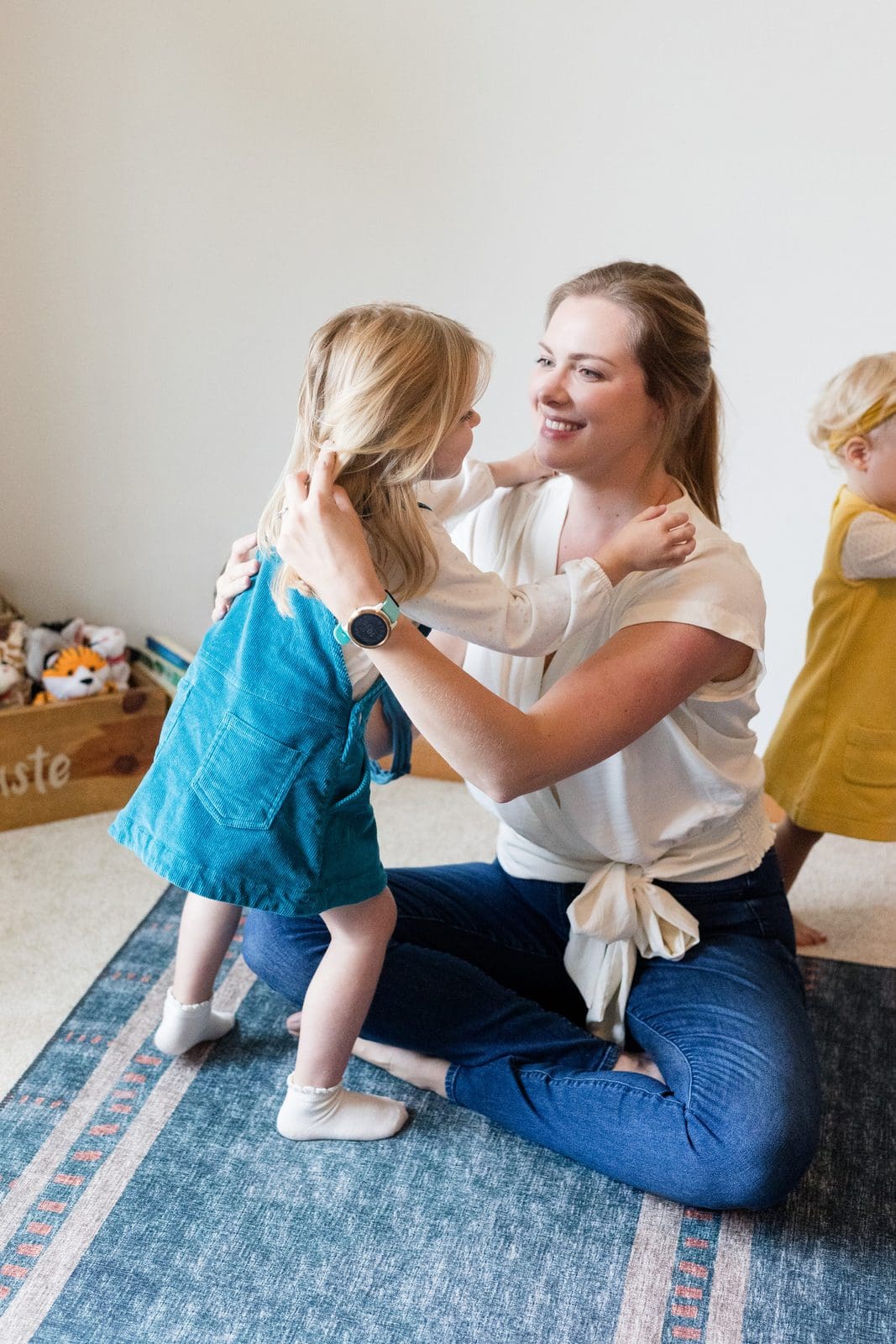


Regulated doesn’t mean zen. Connected doesn’t mean permissive. And it starts with you, getting curious about your own nervous system first.
You’ve probably heard it by now. Stay calm. Regulate yourself. Be the calm in your child’s storm. It’s good advice, and it’s everywhere.
But somewhere along the way, “regulated” started to sound like a personality type. The serene parent who glides through tantrums with a soft voice and a cup of tea. Never rattled. Never firm. Never anything but zen.
If that’s the bar, most of us fail by 8am.
Here’s what I want you to know: that’s not what regulation actually is. And it doesn’t start with your child. It starts with you, and with something quieter than staying calm. It starts with getting curious about your own nervous system.

It Starts With You
We can’t give our children a calm we don’t have access to ourselves. Before any script or strategy, the real work is noticing what happens in your body when things get hard, because you can’t shift a pattern you can’t see yet.
So this is the first practice, and it is a practice, not a personality trait: get curious. When your child melts down, refuses, or pushes every button you have, what happens in you? Do you rev up? Or do you go quiet and disappear?
Naming that pattern isn’t self-criticism. It’s the beginning of change.
Two Ways We Lose It: The Watchdog and the Possum
A framework I love from Robyn Gobbel gives us language for this. She describes three brain states, owl, watchdog, and possum, and it has become one of the most useful things I share with families. She has a free overview of it on her website that I’d encourage you to go read, and her book Raising Kids with Big, Baffling Behaviors goes deeper still.
Here’s the short version. When we feel unsafe or overwhelmed, our nervous system tends to move in one of two protective directions.
The watchdog is the revved-up one. Activated, alert, ready to fight or fix or control. This is the parent who snaps, raises their voice, lectures, or feels the heat rise fast. If big feelings were weather, the watchdog is stormy seas, choppy and churning.
The possum is the shut-down one. Checked out, numb, flat, quietly going through the motions or retreating into your phone. This is the parent who goes silent, disconnects, or feels themselves sink and disappear. If the watchdog is stormy seas, the possum is the deep sea, still and far below the surface.
Here’s the part that matters: neither of these is a character flaw. Both are your nervous system doing exactly what it was built to do, protect you. The watchdog and the possum aren’t bad parenting. They’re biology.
And they need different things to come back, which is exactly why “just take a deep breath and calm down” doesn’t work for everyone.
What Regulation Actually Is
Regulation is not the absence of feeling, and it is definitely not passive. It’s noticing where you’ve gone, watchdog or possum, and finding your way back to steady. In Gobbel’s language, that steady, clear-headed state is the owl: awake, aware, able to think and connect. It’s home base.
For the watchdog, coming back to owl means slowing down. Feeling the rev and easing off it. A long exhale, unclenching your jaw, dropping your shoulders, giving the surge somewhere to go.
For the possum, it’s the opposite. You don’t need to calm down, you’re already shut down. You need to gently come back online. Feel your feet on the floor. Stand up. Take a sip of water. Name one thing you can see. Put a hand on your child. Small re-engagement, until the lights come back on.
Either way, regulation is active. You still feel the wave, or the pull to disappear. You just don’t let it drive. That’s not zen. That’s skill.
Anchor First, Then Harbor
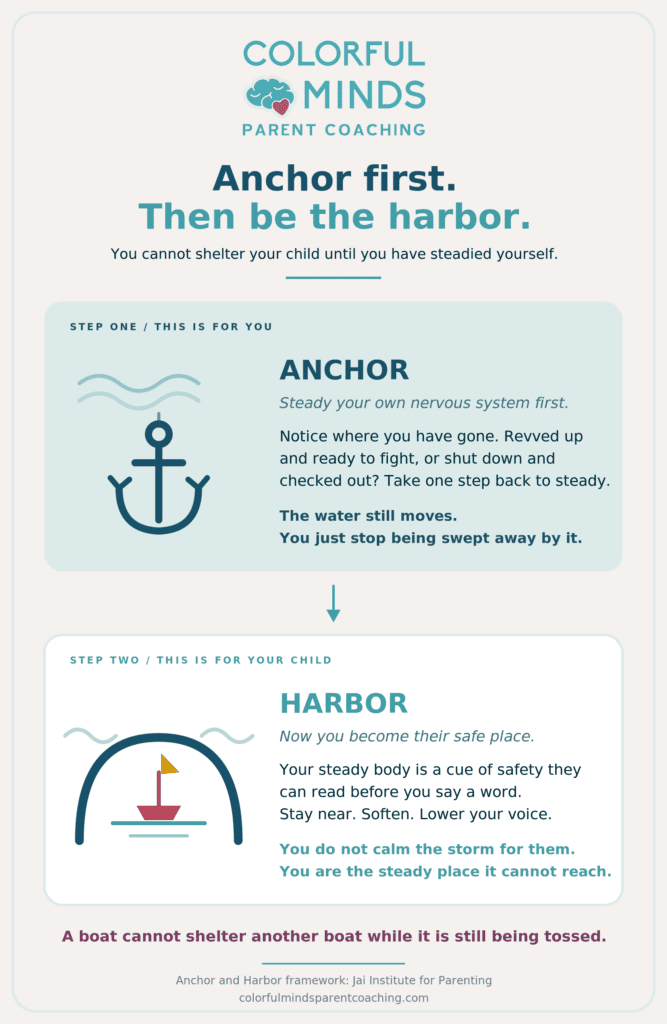
Once you can find your way back to steady, there’s a beautiful way to think about what happens next. It comes from my training with the Jai Institute for Parenting: we anchor, and then we harbor.
Anchoring is you steadying yourself, your own nervous system, first. The harbor is what you become for your child once you’re anchored, the calm, safe place they can pull into while their own feelings churn.
You anchor first so you can be the harbor. It has to happen in that order. A boat can’t shelter another boat while it’s being tossed around itself. And when you’re anchored, your steadiness becomes a cue of safety your child’s nervous system can read, before you say a single word.
That’s co-regulation, and it’s the foundation of everything.
Regulated Doesn’t Mean Permissive
Here’s where a lot of gentle, connection-based parenting gets misread, sometimes by the parents trying hardest to do it well.
Being anchored and warm does not mean anything goes. It does not mean you drop the boundary because your child is upset. It does not mean you absorb every behavior with a soft smile and no limits. That isn’t regulation, and it isn’t connection. It’s permissiveness, and children actually feel less safe when the adult in charge disappears.
Regulation is what lets you hold the limit AND stay kind. “I won’t let you hit your sister. I’m right here, and I’m not going anywhere.” Calm and firm at the same time. Warm, and a hard no.
There’s a way I think about this with the families I work with. Parenting over is control-heavy, running on “because I said so.” Parenting under is boundary-light, caving when things get hard. Parenting with is the middle path: in charge and connected at once. You hold the limit and the relationship, together.
The Skills Aren’t Built Yet, So We Model Them
Here’s the piece that changes everything.
When your child falls apart over something small, it’s tempting to think they’re choosing it. But the skills those moments require, impulse control, flexibility, managing disappointment, calming a flooded body, aren’t fully built yet. The part of the brain that runs them isn’t finished developing until the mid-twenties.
So your child isn’t refusing to use skills they have. They’re missing skills they haven’t developed yet. And missing skills don’t get taught by punishment, any more than a missing multiplication fact gets taught by yelling.
Those hard moments aren’t only problems to shut down. They’re the classroom. When you anchor, harbor, hold the limit, and walk your child through it, you’re modeling the very skill they can’t do yet: feeling something big and staying in one piece.
And here’s the honest part: we’re often still learning it too. You don’t have to have mastered your own nervous system to help your child with theirs. You just have to keep practicing, out loud, alongside them.
What This Looks Like in Real Life: The CALM Framework
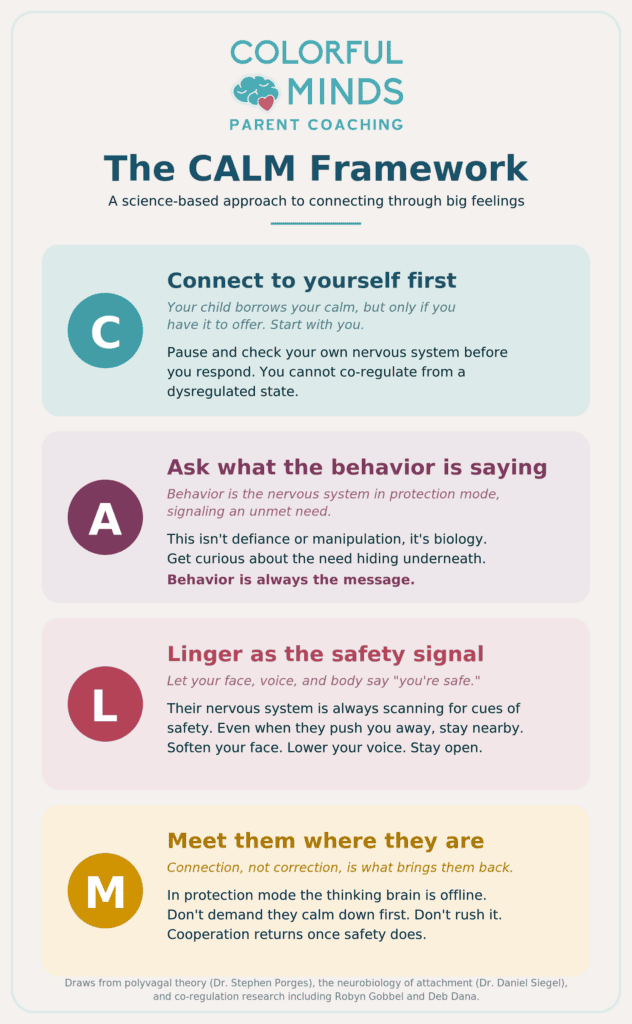
Everything above is the why. This is the how, and it’s the framework I walk through with every family I work with. When the hard moment hits, CALM gives you somewhere to put your feet.
Use it before you respond, in the middle of the storm, or afterward as a guide for repair.
C: Connect to yourself first
Your child borrows your calm, but only if you have it to offer.
Before you respond to the behavior, pause and check your own nervous system. Watchdog, revved and ready to fight? Or possum, shutting down and checking out? Then anchor with the move that fits. Watchdog: slow down, long exhale, drop your shoulders. Possum: come back online, feet on the floor, stand up, name one thing you see.
You cannot co-regulate from a dysregulated state. This isn’t about being perfectly regulated. It’s about noticing where you are and taking one small step back toward calm before you step toward your child.
A: Ask what the behavior is saying
Behavior is the nervous system in protection mode, signaling an unmet need.
Instead of asking “how do I stop this?”, get curious: what is my child’s nervous system trying to tell me? What need for safety, connection, or comfort is hiding underneath?
This isn’t defiance or manipulation. It’s biology. Behavior is always the message.
L: Linger as the safety signal
Let your face, voice, and body say “you’re safe.”
Your child’s nervous system is constantly scanning for cues of safety or threat, a process called neuroception. Your face, voice, and body are all part of that scan.
This is where you become the harbor. Even when your child pushes you away, their nervous system still needs to know you’re safe and available. Stay nearby. Soften your face. Lower your voice. Keep your body open.
M: Meet them where they are, not where you want them to be
Connection, not correction, is what brings them back.
In protection mode, the thinking brain is offline. Teaching, correcting, and problem-solving don’t land yet. That doesn’t mean the limit disappears. You can hold the boundary and the feeling at the same time: “You really wanted that. I won’t let you grab it. I’m right here.”
Don’t demand they calm down first. Don’t rush it. Once their nervous system returns to safety, cooperation and problem-solving become possible again. That’s when the teaching happens.
And when you miss it, and you will, come back. Repair models regulation better than never slipping ever could.
You Don’t Have to Be Zen
If you’ve been trying to be the calm, quiet, endlessly patient parent and feeling like you’re failing, I want to offer you a different goal.
You don’t have to be unruffled. You don’t have to choose between firm and kind. You just have to keep getting curious, keep connecting to yourself first so you can be the safety signal your child is scanning for, and keep holding your limits with warmth, even while you’re still learning the skills yourself.
That’s regulation. Not zen. Not permissive. Something stronger, and far more human, than either.

Ready to find that steady-and-firm middle in your own home?
I offer a free 30-minute consultation where we can talk through what’s happening in your family and explore what working together could look like. No pressure, just a real conversation. Book your free discovery call or explore the different ways we can work together.


