





What I learned the night I couldn’t comfort my crying baby
The baby monitor crackled to life at 2:47 AM. Again.
I dragged myself out of bed, my body protesting every movement. This was the fourth wake-up that night. Or was it the fifth? The days and nights had blurred together into one endless cycle of feeding, changing, soothing, repeat.
I picked up my crying baby, and something inside me just… broke.
She cried. I cried.
And for the first time since becoming a mother, I had a terrifying thought: I can’t do this.
The Moment I Felt Like a Failure
That night, I wanted so desperately to be the calm, nurturing presence my daughter needed. I wanted to soothe her, rock her gently, whisper reassuring words. I wanted to be everything I’d imagined a good mother should be.
But I had nothing left to give.
I was completely depleted—emotionally, physically, mentally. My cup wasn’t just empty; it had cracks running through it. And as I stood there in the dim glow of the nightlight, holding my crying baby while tears streamed down my own face, the shame was overwhelming.
What kind of mother can’t even comfort her own child?
Why am I so weak?
Everyone else seems to handle this. Why can’t I?
The Truth That Changed Everything
It took me a day or two to gain enough distance from that moment to see it clearly. And when I did, I realized something that would eventually shape my entire approach to parenting—and to parent coaching.
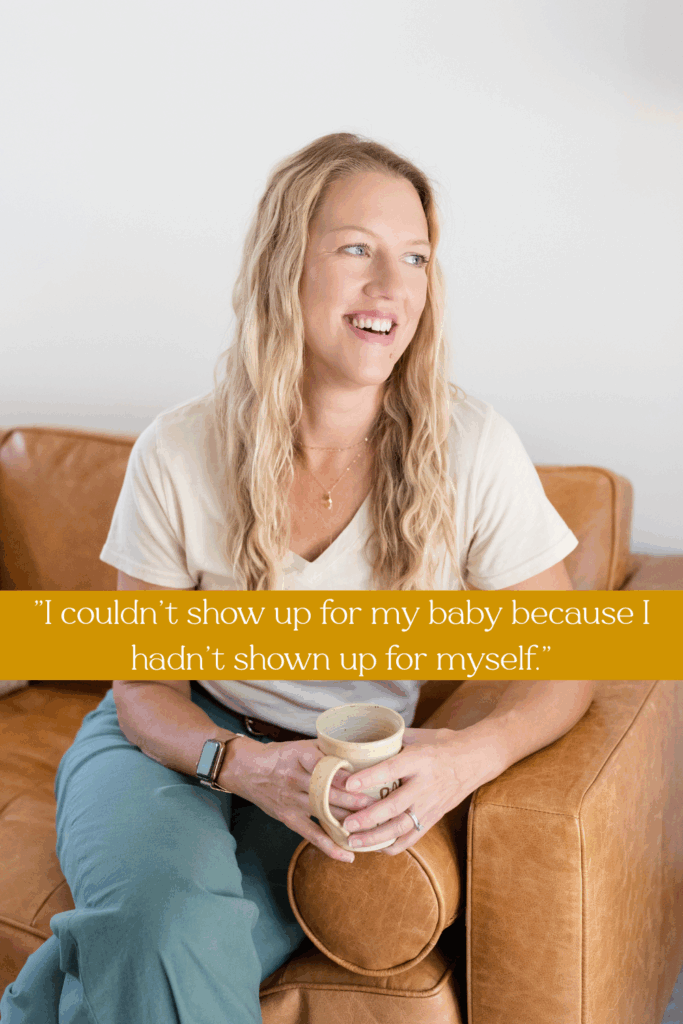
I couldn’t show up for my baby because I hadn’t shown up for myself.
I had been operating under the belief that good mothers sacrifice everything. That putting yourself first is selfish. That your needs come last—always.
But that night taught me a fundamental truth: You cannot pour from an empty cup.
More specifically: You cannot hold space for your child’s big feelings if you haven’t created space for your own.
What “Showing Up” Really Means
One of my favorite parenting resources is The Power of Showing Up by Dr. Daniel Siegel and Dr. Tina Payne Bryson. Their research reveals something both revolutionary and beautifully simple:
Your children don’t need you to be perfect. They need you to be present.
They need you to show up—calm enough to hold space for their emotions without judgment, without immediately trying to fix things, without expectations for how they “should” feel.
But here’s what most parenting advice misses, and what I learned that exhausting night:
You can’t show up calmly and fully for your children if you’re running on empty yourself.
The Four S’s of Secure Attachment
Siegel and Bryson identify four essential qualities that children need from their caregivers:
- Safe – physically and emotionally protected
- Seen – noticed and understood for who they truly are
- Soothed – comforted during distress
- Secure – confident in the reliability of the relationship
Notice what’s required for each of these? A parent who has the capacity to provide them.
And capacity doesn’t magically appear. It has to be cultivated, protected, and replenished.
The Permission You’ve Been Waiting For
Here’s what I tell every parent I work with, and what I wish someone had told me during those early, overwhelming months:
Taking care of yourself isn’t selfish. It’s essential.
Showing up for yourself unapologetically isn’t taking away from your children—it’s the foundation for showing up for them fully.
This looks different for every parent:
- Maybe it’s taking five minutes to breathe before getting out of bed
- Maybe it’s eating an actual meal instead of surviving on coffee and toddler leftovers
- Maybe it’s asking for help without apologizing
- Maybe it’s going to bed at 8 PM because you need sleep more than you need to fold laundry
- Maybe it’s saying “I need a break” and taking one
None of these things make you a bad parent. They make you a human being with needs—needs that matter just as much as your children’s needs.
What This Looks Like in Real Life
Fast forward to today. I’m still a mom of two. There are still hard days. Still moments when I feel depleted.
But now, I recognize the warning signs. I know what happens when I let my cup run dry. And I’ve learned—slowly, imperfectly—to show up for myself with the same compassion I extend to my children.
Some days, this looks like:
- Prioritizing my yoga practice even when the house is a mess
- Saying no to commitments that drain me
- Asking my partner to take the kids so I can have 30 minutes alone
- Letting myself feel overwhelmed without shame
- Modeling self-care for my daughters (kitchen dance parties count!)
Is it perfect? Never.
But it’s real. And it’s sustainable.
Your Invitation: Get Curious
If you’re reading this and feeling that familiar tightness in your chest—that sense of running on fumes while everyone needs something from you—I want you to pause.
Take a breath.
And get curious:
How are you showing up for yourself?
Not as a parent. Not as a partner, employee, or friend.
Just you.
- When was the last time you did something that replenished you?
- Are you eating nourishing meals, or just surviving?
- Do you have any time in your day that’s truly yours?
- How full (or empty) is your cup right now?
Notice your answers without judgment. You’re not failing if they’re uncomfortable. You’re simply becoming aware—and awareness is always the first step toward change.
The Connection Between Self-Care and Calm Parenting
Here’s where the brain science comes in (and trust me, this matters):
When you’re depleted, your nervous system operates in survival mode. Your brain perceives threat everywhere. Your ability to regulate your emotions decreases. Your capacity for patience, creativity, and connection shrinks.
In other words: A depleted parent cannot be a regulated parent.
And children need regulated parents.
Not perfect parents. Not parents who never lose their cool. But parents who can stay calm enough, often enough, to be their safe harbor during emotional storms.
This is what I call the CALM approach:
- Connect with yourself first
- Acknowledge your own needs
- Lean into self-compassion
- Make space for what replenishes you
Only then can you consistently show up as the calm, connected parent your children need.
How to Actually Fill Your Cup (Practical Steps)
Okay, enough philosophy. Let’s get practical. Here are five tangible ways to start filling your cup today:
1. The Morning Minute
Before you get out of bed, take 60 seconds to check in with yourself. Place your hand on your heart and ask: “What do I need today?” Don’t judge the answer. Just listen.
2. The Permission Slip
Write yourself literal permission slips. “I give myself permission to rest.” “I give myself permission to ask for help.” “I give myself permission to feel overwhelmed.” Keep them where you’ll see them.
3. The Non-Negotiable
Pick ONE thing each day that’s just for you and make it non-negotiable. Five minutes of stretching. A cup of coffee you actually sit down to drink. Three deep breaths in your car before going inside. Start small.
4. The Boundary Practice
Practice saying: “I need a moment” or “I need to step away” without apologizing or explaining. Your needs don’t require justification.
5. The Refill Ritual
Create a simple ritual that signals to your nervous system: “I’m taking care of me now.” It could be lighting a candle, putting on a specific playlist, or making that special tea. The ritual matters less than the consistent message it sends.
Moving Forward
That moment in the middle of the night—crying alongside my crying baby—was one of the hardest of my life. But it was also a gift.
It showed me that I couldn’t keep going the way I’d been going. It forced me to question the narrative that good mothers sacrifice everything. And it ultimately led me to this work—helping other parents understand that taking care of themselves isn’t optional.
It’s the foundation.
So if you’re reading this while feeling depleted, overwhelmed, or like you’re barely holding it together, I want you to know:
You’re not broken. Your child’s not broken. You just need to refill your cup.
And that starts with giving yourself permission to show up—for you.
Because here’s the truth that took me years to learn: When you show up for yourself with compassion and without apology, you’re not taking away from your children. You’re teaching them the most important lesson they’ll ever learn—that they deserve to take care of themselves too.
Ready to Transform How You Show Up?
If you’re tired of running on empty and ready to discover what calm, connected parenting can feel like when you’re taking care of yourself too, I’d love to support you.
Book a Free 30-Minute Consultation – Let’s talk about what’s draining your cup and how to start filling it again.
Download My Free Guide: “The CALM Parent Quick-Start” – Five simple practices to begin showing up differently—starting today.
Join Our Newsletter: Colorful Minds, Calm Hearts – Weekly brain science, practical strategies, and gentle reminders delivered to your inbox every Tuesday.
About Amy
I’m a parent coach with a Master’s degree in Early Childhood Special Education and over 13 years supporting families. But more importantly, I’m a mom who learned the hard way that you can’t pour from an empty cup. Now I help parents create the calm, connected family life they’ve been dreaming of—without sacrificing themselves in the process.
When I’m not coaching families, you’ll find me at my daughters’ soccer games, having kitchen dance parties where I sing way too loud, or prioritizing my own wellness through yoga and weight training—because I practice what I preach about filling your own cup first.
Have you experienced that moment of feeling too depleted to show up? I’d love to hear your story. Drop a comment below, explore my parent coaching services or book a free discovery call with me here.


